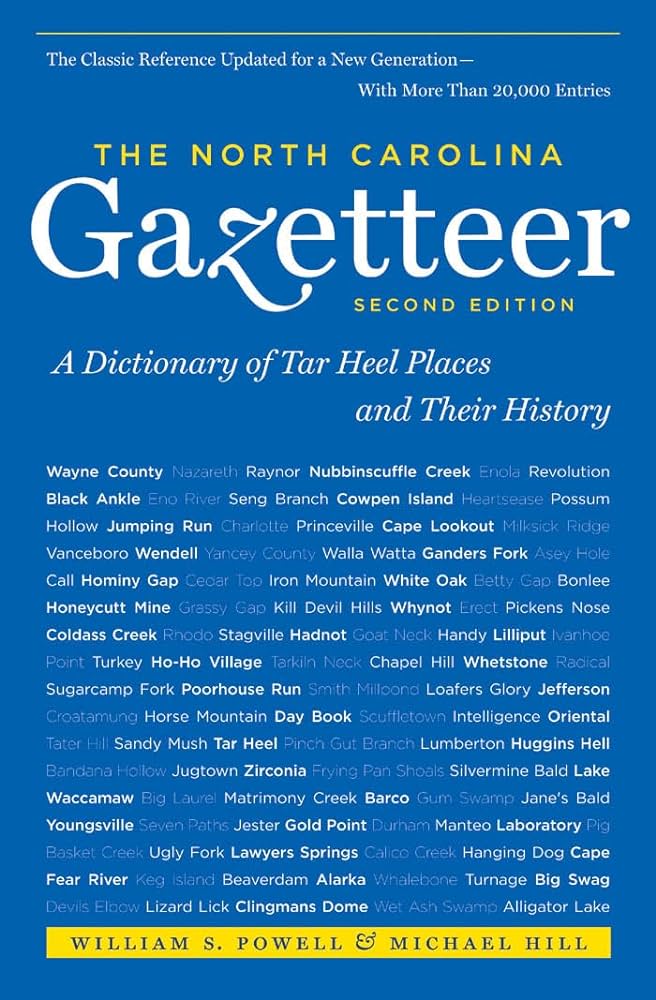
This content is from the North Carolina Gazetteer, edited by William S. Powell and Michael Hill. Copyright © 2010 by the University of North Carolina Press. Used by permission of the publisher. For personal use and not for further distribution. Please submit permission requests for other use directly to the publisher.

Some place names included in The North Carolina Gazetteer contain terms that are considered offensive.

"The North Carolina Gazetteer is a geographical dictionary in which an attempt has been made to list all of the geographic features of the state in one alphabet. It is current, and it is historical as well. Many features and places that no longer exist are included; many towns and counties for which plans were made but which never materialized are also included. Some names appearing on old maps may have been imaginary, but many of them also appear in this gazetteer.

Each entry is located according to the county in which it is found. I have not felt obliged to keep entries uniform. The altitude of a place, the date of incorporation of a city or town, may appear in the beginning of one entry and at the end of another. Some entries may appear more complete than others. I have included whatever information I could find. If there is no comment on the origin or meaning of a name, it is because the information was not available. In some cases, however, resort to an unabridged dictionary may suggest the meaning of many names."

--From The North Carolina Gazetteer, 1st edition, preface by William S. Powell
Alphabetical Glossary Filter

"
3
A
B
C
D
E
F
G
H
I
J
K
L
M
N
O
P
Q
R
S
T
U
V
W
X
Y
Z
Place Description
East Kings Mountain

former town in W Gaston County on the Cleveland County line. Inc. 1907. By popular vote, it was transferred to Cleveland County in 1915. Became a part of Kings Mountain, which see, in 1923.

East Lake

lake on the mainland of N Dare County, empties into the mouth of Alligator River.

East Lake Landing

NW Dare County on Alligator River. State-operated free ferry from the landing to Sandy Point in NE Tyrrell County was replaced by the Lindsay C. Warren Bridge, 2.83 mi. long and opened in May 1962; named for Lindsay C. Warren (1889-1976), former U.S. congressman and comptroller general.

East Lake Township

NW Dare County mainland.

East Laport

community in N Jackson County on Tuckasegee River. Developed at the site of an eighteenth-century French trading post that the French considered to be an east gate or door (la porte) to the Cherokee country. Alt. 2,186.

East Laurinburg

town in S Scotland County. Inc. 1903 as Scotland Village; name changed, 1909.

East Lumberton

former town in E central Robeson County. Inc. 1901. Charter repealed 1953. Now a part of Lumberton. Was a mill-owned village until 1950, when houses were sold to individuals.

East Mayo Mountain

See Baughn Mountain.

East Mingo Branch

rises in SW Johnston County and flows S to join Black River in forming South River on the Cumberland-Sampson county line. For a part of its course, it forms the boundary between Johnston and Harnett Counties and between Harnett and Sampson Counties. Sometimes known as Mingo Swamp. Appears as Black Mingo on the Collet map, 1770. Mingo was an Indian word for a treacherous person. It was also frequently used as a slave name, appearing as such as early as 1680 in Albemarle County. See also Black Creek Swamp.

East Monbo

now covered by waters of Lake Norman but formerly a community on the Catawba River in W Iredell County. A cotton mill was est. there in the late nineteenth century and named Mont Beau (beautiful mountain) by its owners. The natives soon corrupted the name to Monbo and, since it was on the E side of the river, it became East Monbo (there being another mill on the W side of the river in Catawba County). East Monbo was long a popular picnic and swimming site.