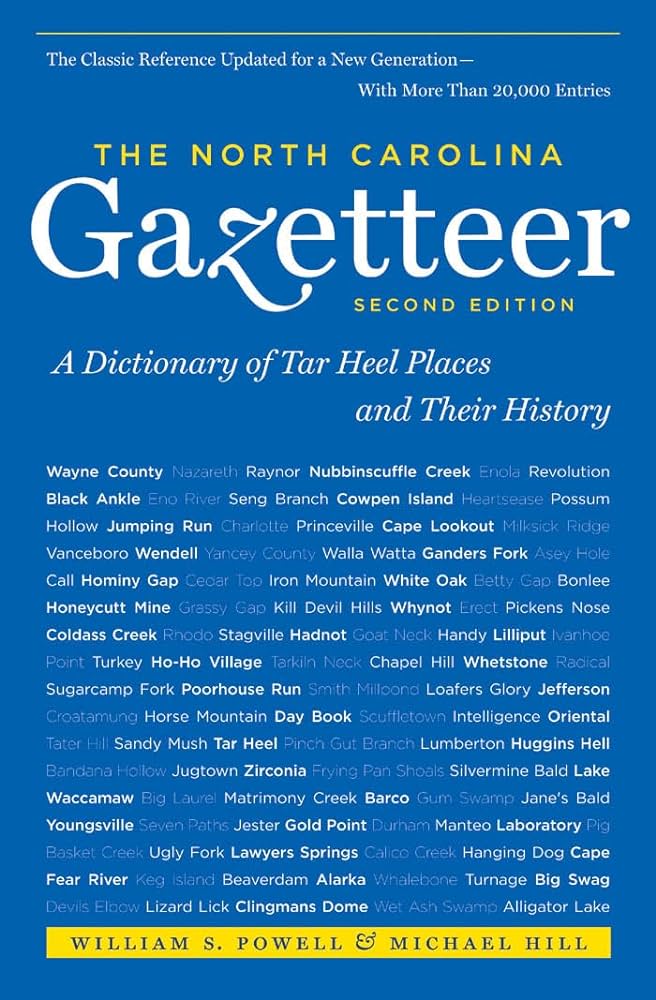
This content is from the North Carolina Gazetteer, edited by William S. Powell and Michael Hill. Copyright © 2010 by the University of North Carolina Press. Used by permission of the publisher. For personal use and not for further distribution. Please submit permission requests for other use directly to the publisher.

Some place names included in The North Carolina Gazetteer contain terms that are considered offensive.

"The North Carolina Gazetteer is a geographical dictionary in which an attempt has been made to list all of the geographic features of the state in one alphabet. It is current, and it is historical as well. Many features and places that no longer exist are included; many towns and counties for which plans were made but which never materialized are also included. Some names appearing on old maps may have been imaginary, but many of them also appear in this gazetteer.

Each entry is located according to the county in which it is found. I have not felt obliged to keep entries uniform. The altitude of a place, the date of incorporation of a city or town, may appear in the beginning of one entry and at the end of another. Some entries may appear more complete than others. I have included whatever information I could find. If there is no comment on the origin or meaning of a name, it is because the information was not available. In some cases, however, resort to an unabridged dictionary may suggest the meaning of many names."

--From The North Carolina Gazetteer, 1st edition, preface by William S. Powell
Alphabetical Glossary Filter

"
3
A
B
C
D
E
F
G
H
I
J
K
L
M
N
O
P
Q
R
S
T
U
V
W
X
Y
Z
Place Description
Crisp

community in S Edgecombe County.

Crisp Creek

rises in W Martin County and flows SW into SW Edgecombe County. It then flows SE and forms a portion of the Edgecombe-Pitt county line before entering Conetoe Creek.

Crit

community in SE Clay County served by post office, 1898-1906.

Croaker Channel

W Carteret County in White Oak River. Named for a species of fish. Formerly one of two channels used to reach Swansboro in the days of sailing vessels. Boats moving up Bogue Sound used Croaker Channel, while those approaching from the Atlantic Ocean used Ship (or West) Channel. Croaker Channel is now almost completely filled with sand.

Croatamung

an island shown on the White map, 1585, in what is now a part of Currituck Banks in E Currituck County. Smith, 1624, calls it Arundells Island; Comberford, 1657, makes it Lucks Island. As the latter, is the N boundary of the Carolina territory granted to the Lords Proprietors in 1663. See also Lucks Island.

Croatan

community in E Craven County. Settled about 1800. Alt. 28.

Croatan National Forest

in parts of Carteret, Craven, and Jones Counties. Est. 1933. Covers 294,610 acres. Includes the Croatan Cooperative Wildlife Management Area. Headquarters are in New Bern.

Croatan Sound

connects Albemarle and Pamlico Sounds between Roanoke Island and the mainland of Dare County. Appears as The Narrows on the Moseley map, 1733. Virginia Dare Memorial Bridge, opened 2002 and 5 mi. in length, spans the sound to connect Roanoke Island to Manns Harbor.

Croatan Township

central Dare County on the mainland.

Croatoan Island

a name applied by John White on his map of 1585 to the S portion of Hatteras Island (Dare County) and a portion of Ocracoke Island (Hyde County). Hatteras Inlet, now dividing this portion of the Outer Banks into two islands, was opened in 1846. Ralph Lane, governor of the first Roanoke colony, named the island "My Lord Admirals Iland" in honor of Lord Howard of Effingham, created Lord High Admiral in 1585. By 1657 Comberford showed the island as "Chowanoke." Smith, in 1624, had called it Abbots Island. The name Croatoan was derived from the Indian village that was on the present Cape Hatteras (Kro-otän [talk town], indicating the chief's residence.) See also Portsmouth Island.